Points of Contact: The Shared Intellectual History of Vocalisation in Syriac, Arabic, and Hebrew (2021)
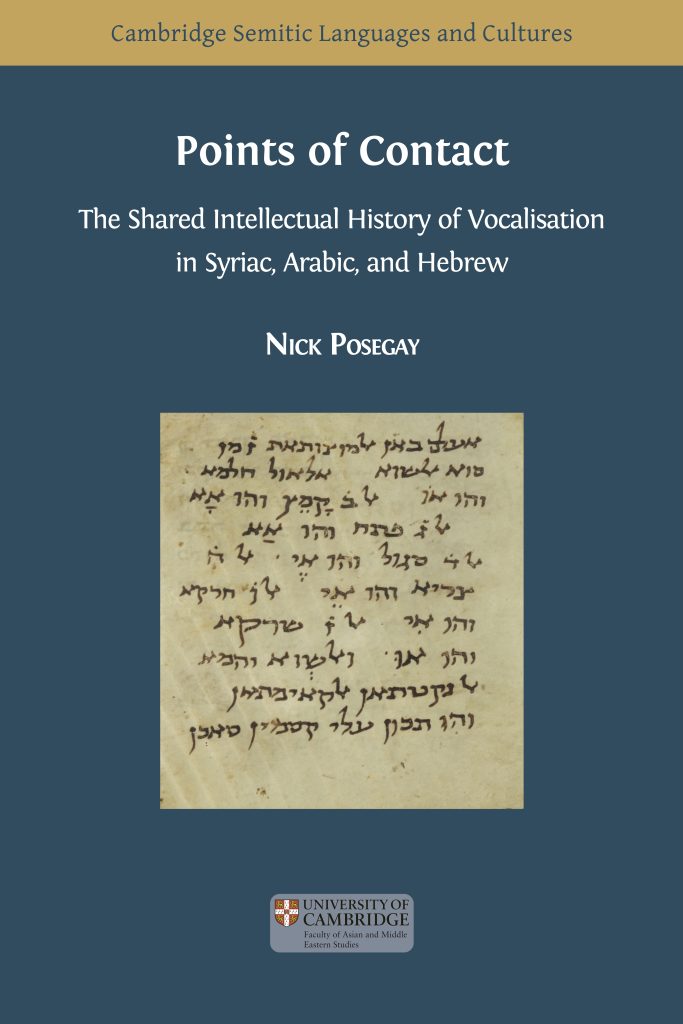
In the first few centuries of Islam, Middle Eastern Christians, Muslims, and Jews alike all faced the challenges of preserving their holy texts in the midst of a changing religious landscape. This situation led Syriac, Arabic, and Hebrew scholars to develop new fields of linguistic science in order to better analyse the languages of the Bible and the Qurʾān. Part of this work dealt with the issue of vocalisation in Semitic scripts, which lacked the letters required to precisely record all the vowels in their languages. Semitic scribes thus developed systems of written vocalisation points to better record vowel sounds, first in Syriac, then soon after in Arabic and Hebrew. These new points opened a new field of linguistic analysis, enabling medieval grammarians to more easily examine vowel phonology and explore the relationships between phonetics and orthography. Many aspects of this new field of vocalisation crossed the boundaries between religious communities, first with the spread of ‘relative’ vocalisation systems prior to the eighth century, and later with the terminology created to name the discrete vowels of ‘absolute’ vocalisation systems. This book investigates the theories behind Semitic vocalisation and vowel phonology in the early medieval Middle East, tracing their evolution to identify points of intellectual contact between Syriac, Arabic, and Hebrew linguists before the twelfth century.*
Read here: https://doi.org/10.17613/xf0ws-dfv87
Cite this work: Posegay, Nick. 2021. Points of Contact: The Shared Intellectual History of Vocalisation in Syriac, Arabic, and Hebrew. Cambridge Semitic Languages and Cultures, 10. Cambridge: Open Book Publishers, https://doi.org/10.11647/OBP.0271.
*This book won the British and Irish Association for Jewish Studies’ Annual Book Prize for 2022.