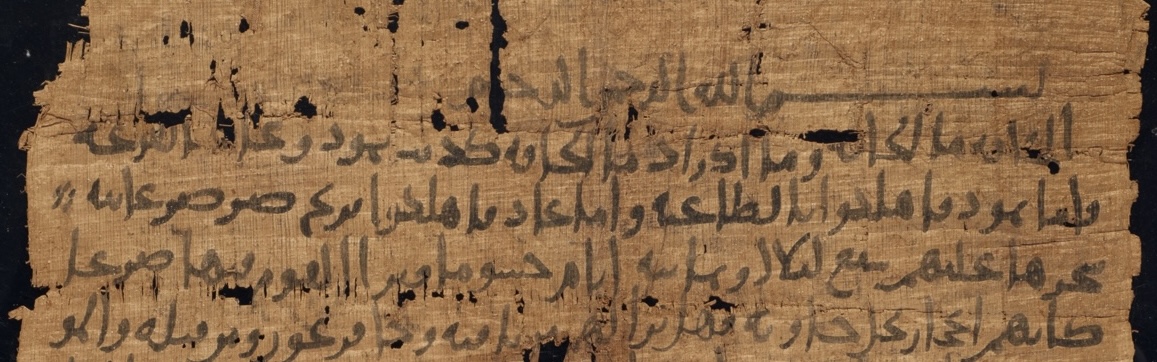
Publications
100% organic, home-grown, slop-free, artisanal publications. No AI use now or ever.
The Illustrated Cairo Genizah (2024)
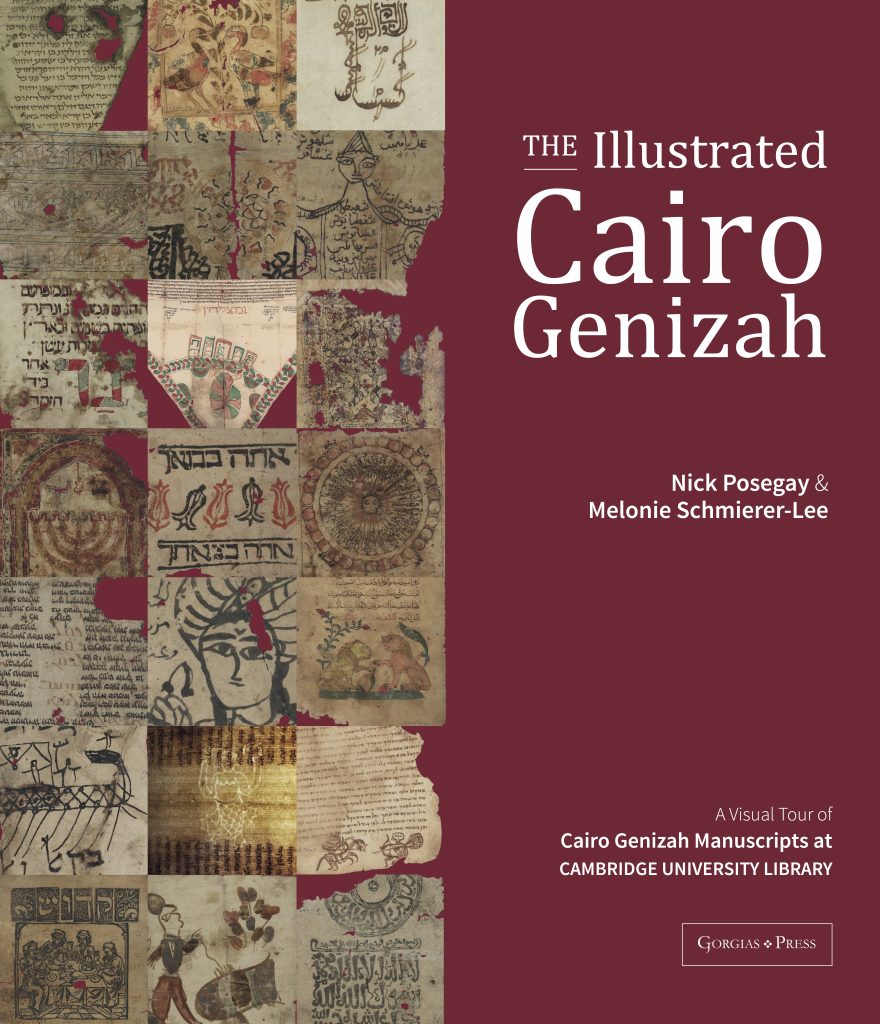
Abstract: Almost one thousand years ago, the Jews of Old Cairo began to place their worn-out books and scrolls into a hidden storage room – a genizah – of their synagogue. Over the years, they added all sorts of writings to the pile, sacred and secular texts alike. When the chamber was emptied at the end of the 19th century, it held hundreds of thousands of paper and parchment fragments. Now known as the ‘Cairo Genizah’, it has become one of the most important sources of knowledge for the history of the Middle East and the Mediterranean world. This book offers the first illustrated introduction to the unique collections of Cairo Genizah manuscripts at Cambridge University Library. Join Genizah experts Nick Posegay and Melonie Schmierer-Lee as they take you on a journey of discovery through more than 125 years of research at the University of Cambridge, showcasing over 300 stunning, full-colour manuscript images across 12 thematic chapters. From ancient Bibles to medieval magic and Renaissance printing presses, The Illustrated Cairo Genizah reveals the forgotten stories of Jewish, Muslim, and Christian communities at the centre of a millennium of world history.
Read here: https://doi.org/10.17613/z7cb4-9dq71
Cite this work: Posegay, Nick and Melonie Schmierer-Lee. 2024. The Illustrated Cairo Genizah. Piscataway, NJ: Gorgias Press.
From the Battlefield of Books (2024)
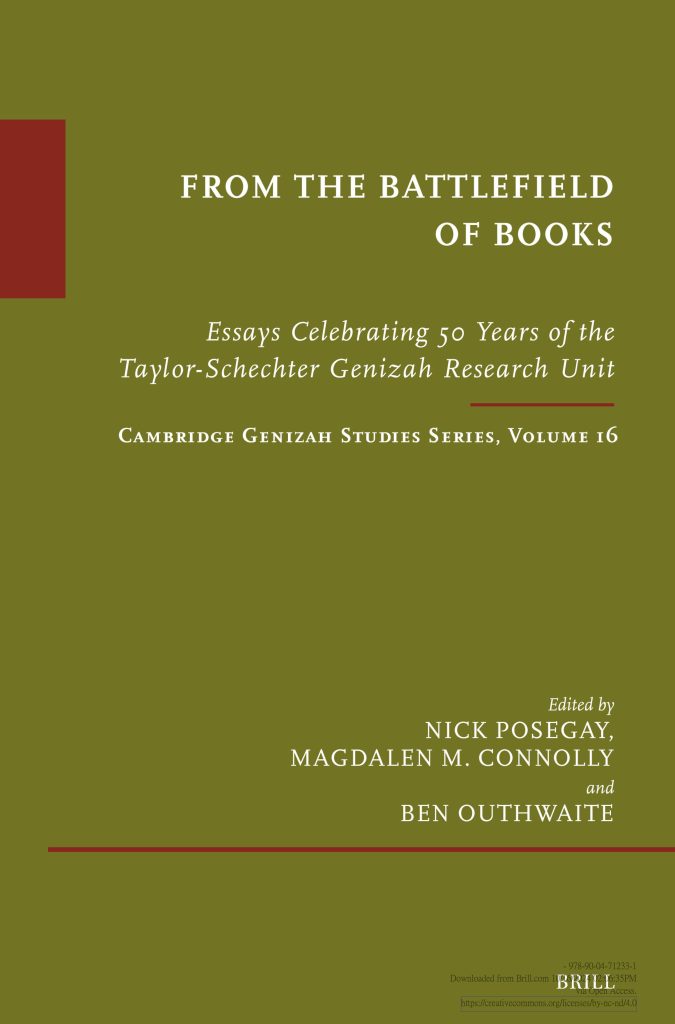
Abstract: This collection of essays celebrates 50 years since the founding of the Taylor-Schechter Genizah Research Unit at Cambridge University Library. Three generations of scholars contributed their research and memories from their time at the GRU, stretching back to 1974. Their work comprises 18 articles on medieval Jewish History, Hebrew and Arabic manuscripts, archival history, and the story of the Cairo Genizah collections at the University of Cambridge. Together, they demonstrate the achievements of GRU alumni in advancing the field of Genizah Studies for more than five decades.
Read here: https://doi.org/10.17613/289q0-s7n47
Cite this work: Posegay, Nick, Magdalen M. Connolly, and Ben Outhwaite (eds). 2024. From the Battlefield of Books: Essays Celebrating 50 Years of the Taylor-Schechter Genizah Research Unit. Cambridge Genizah Studies Series, 16. Leiden: Brill, https://doi.org/10.1163/9789004712331.
Points of Contact (2021)
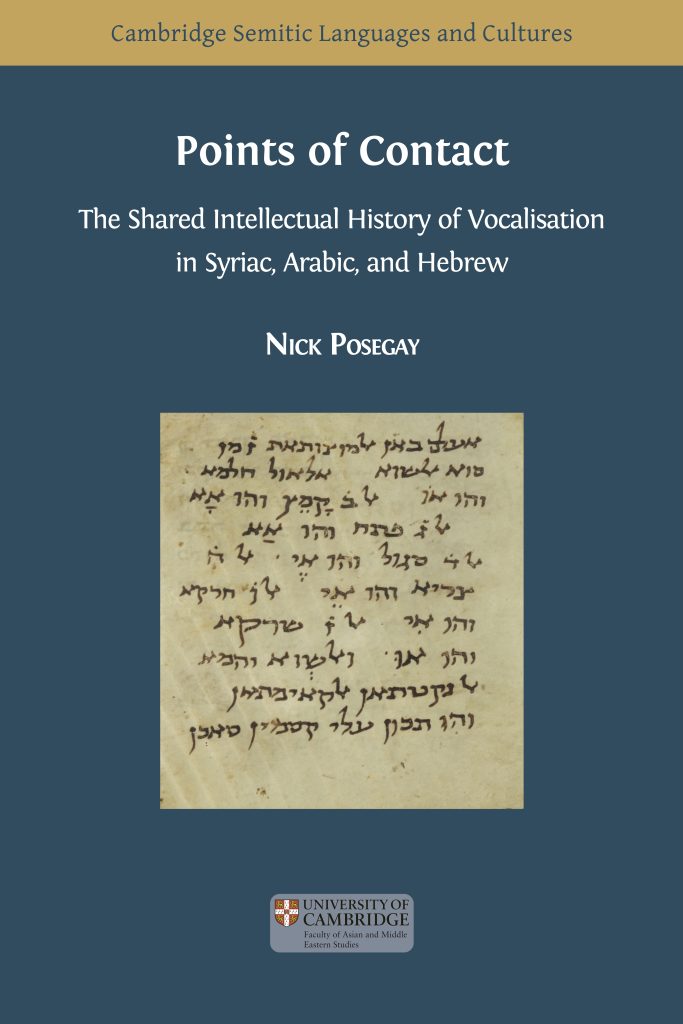
Abstract: In the first few centuries of Islam, Middle Eastern Christians, Muslims, and Jews alike all faced the challenges of preserving their holy texts in the midst of a changing religious landscape. This situation led Syriac, Arabic, and Hebrew scholars to develop new fields of linguistic science in order to better analyse the languages of the Bible and the Qurʾān. Part of this work dealt with the issue of vocalisation in Semitic scripts, which lacked the letters required to precisely record all the vowels in their languages. Semitic scribes thus developed systems of written vocalisation points to better record vowel sounds, first in Syriac, then soon after in Arabic and Hebrew. These new points opened a new field of linguistic analysis, enabling medieval grammarians to more easily examine vowel phonology and explore the relationships between phonetics and orthography. Many aspects of this new field of vocalisation crossed the boundaries between religious communities, first with the spread of ‘relative’ vocalisation systems prior to the eighth century, and later with the terminology created to name the discrete vowels of ‘absolute’ vocalisation systems. This book investigates the theories behind Semitic vocalisation and vowel phonology in the early medieval Middle East, tracing their evolution to identify points of intellectual contact between Syriac, Arabic, and Hebrew linguists before the twelfth century.*
Read here: https://doi.org/10.17613/xf0ws-dfv87
Cite this work: Posegay, Nick. 2021. Points of Contact: The Shared Intellectual History of Vocalisation in Syriac, Arabic, and Hebrew. Cambridge Semitic Languages and Cultures, 10. Cambridge: Open Book Publishers, https://doi.org/10.11647/OBP.0271.
*This book won the British and Irish Association for Jewish Studies’ Annual Book Prize for 2022.
“The Arabo-Tiberian Vocalisation System: An Undocumented Set of Medieval Vowel Signs for the Hebrew Script” (2025)
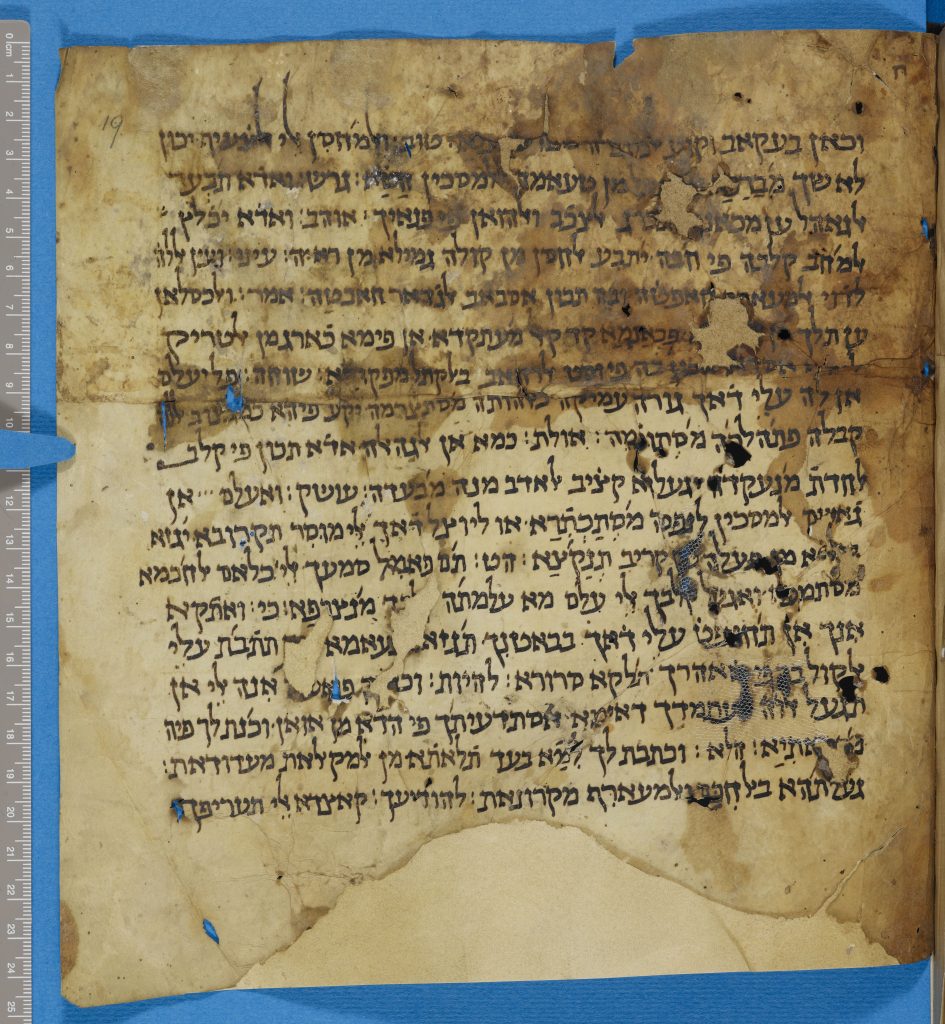
Abstract: The three main Hebrew vocalisation systems—Tiberian, Palestinian, and Babylonian—are well-known in the history of Semitic languages. This article describes another previously undocumented Hebrew vocalisation system, the ‘Arabo-Tiberian system’, a sub-variant of the Tiberian system that appears only in Judaeo-Arabic manuscripts around the tenthand eleventh centuries. In addition to the typical Tiberian vowel marks, the Arabo-Tiberian system includes two loaned Babylonian signs, one for the vowel /u/ and another for /a/ (primarily in the diphthongs /aw/ and /ay/). This system never achieved the widespread adoption or standardisation of other Hebrew and Arabic vowel systems, so it survives now only in fragmentary evidence from the Cairo Genizah. This article describes the common Arabo-Tiberian features in ten vocalised manuscripts and offers hypotheses for the system’s origin and extinction.
Read here: https://works.hcommons.org/records/5mpnv-s5m46
Cite this work: Posegay, Nick. 2025. “The Arabo-Tiberian Vocalisation System: An Undocumented Set of Medieval Vowel Signs for the Hebrew Script.” Folia Orientalia 62, 31-49.
“A Jewish Translation of Genesis in 10th-Century Egyptian Arabic” (2025)
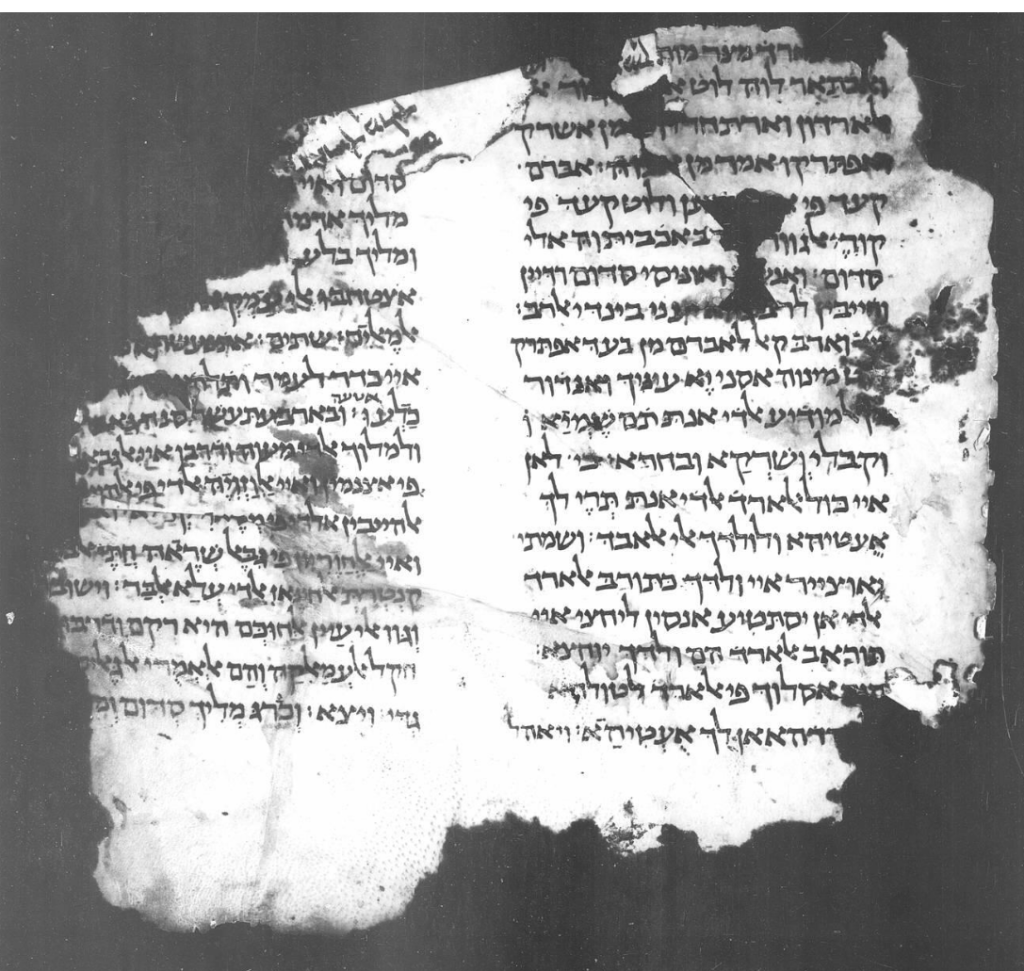
Abstract: MS Firkovitch Yevr. II B 1526 comes from a Judaeo-Arabic translation of the biblical book of Genesis produced no later than the tenth century. It consists of two parchment folios containing most of Genesis 13.10 through 17.1. In total, 146 lines of text survive at least partially intact. They contain a significant number of Tiberian Hebrew vowel signs–uncommon for a Judaeo-Arabic manuscript this old–which record precise Arabic vocalisation. This article presents an edition of Firkovitch Yevr. II B 1526 and analyses the linguistic features preserved by its non-Classical orthography and vocalisation. It shows that, despite the relative prestige of a biblical manuscript of this scale, the scribe who copied it did not transcribe a linguistic register that matches what might be expected of a ‘Classical Arabic’ reading tradition. Instead, they recorded phonetic variations, apparently from their own Arabic dialect, which can be extracted from the extant text to reconstruct a medieval variety of spoken Arabic.
Read here: https://doi.org/10.17613/8n0v3-p5511
Cite this work: Posegay, Nick. 2025. “A Jewish Translation of Genesis in 10th-Century Egyptian Arabic.” The Intertwined World of the Oral and Written Transmission of Sacred Traditions in the Middle East, eds. Alba Fedeli, Geoffrey Khan, and Johan Lundberg. Cambridge Semitic Languages and Cultures, 40. Cambridge: Open Book Publishers, 275-305, https://doi.org/10.11647/obp.0498.07.
“Some Notes on Melody: Saʿadya Gaon and Why ‘Naghma’ Means ‘Vowel’ in Judaeo-Arabic” (2025)

Abstract: The article explores the historical and linguistic contexts behind the use of the term ‘naghma’ in medieval Judaeo-Arabic to signify ‘vowel’, a meaning distinct from its Classical Arabic usage denoting ‘melody’, ‘tone’, or ‘sound’. Focusing on Saʿadya Gaon’s work, particularly his al-Qawl fī al-Nagham (‘Discourse on Melody’), the study highlights how the concept of ‘tone’ or ‘note’ evolved in Jewish linguistic traditions. Saʿadya used naghma to describe the seven vowels of Tiberian Hebrew, connecting linguistic analysis with musicological concepts prevalent in Arabic and Jewish intellectual circles of the medieval period. By equating vowels with musical notes, he introduced a metaphysical layer to Hebrew grammar, suggesting that vocalisation carried both linguistic and spiritual significance. This innovative usage influenced subsequent Judaeo-Arabic and Masoretic texts, embedding the term in the medieval Jewish linguistic tradition.
Read here: https://doi.org/10.11647/obp.0464.10
Cite this work: Posegay, Nick. 2025. “Some Notes on Melody: Saʿadya Gaon and Why ‘Naghma’ Means ‘Vowel’ in Judaeo-Arabic.” Interconnected Traditions: Semitic Languages, Literatures, Cultures—A Festschrift for Geoffrey Khan, Volume 2, eds. A. Hornkohl, N. Vidro, J.C.E. Watson, E. Coghill, M.M. Connolly, and B. Outhwaite. Cambridge Semitic Languages and Cultures, 35. Cambridge: Open Book Publishers, 311-340.
“Following the Mediterranean Paper Trail: A Study of European Paper in Late Medieval Cairo (c. 1350–1600)” (2024)
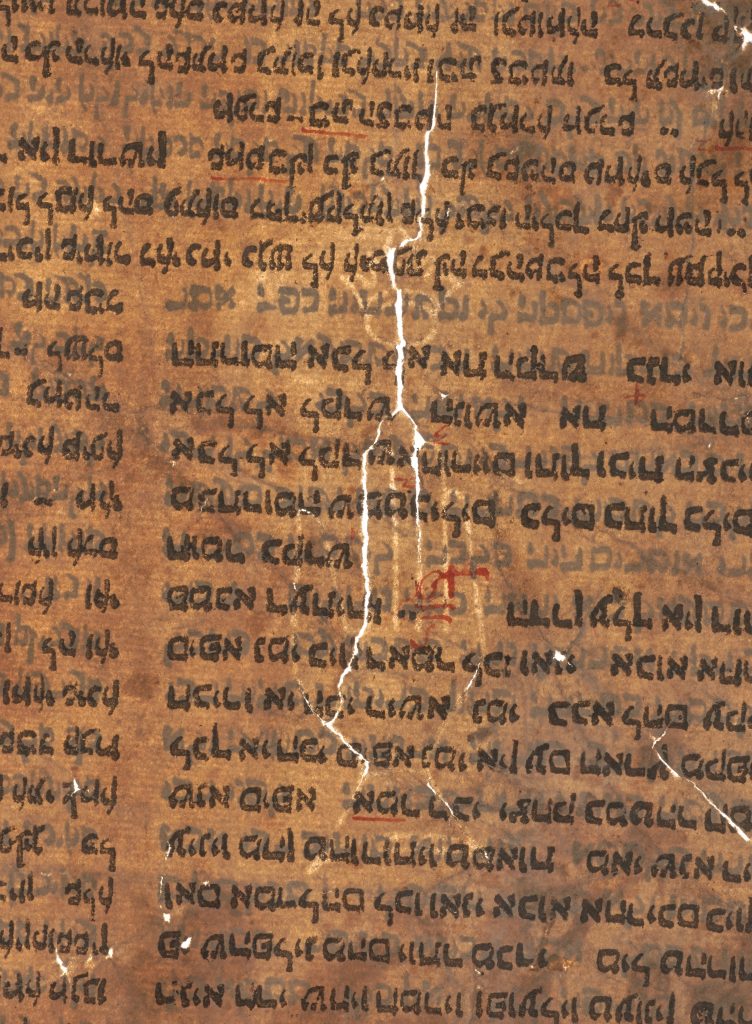
Abstract: This article seeks to cross disciplinary boundaries while examining watermark paper in the ‘Cairo Genizah’ manuscript collections at the Cambridge University Library. Mainly dating between 1100 and 1897, this corpus provides a continuous cross-section of Egyptian-Jewish literary activity during the entire transition to watermark paper, including samples of paper stocks used in Cairo, Alexandria, Rosetta, Guadalajara, Híjar, Lisbon, Faro, Salonika, Constantinople, and Jerusalem, among other places. As we shall see, Genizah data about these stocks can supplement the study of paper in Egypt, Italy, Iberia, and the Ottoman Empire between 1350 and 1600. It also presents new opportunities for collaboration between European and Middle Eastern historians that will enhance the current understanding of papermaking and trade around the Mediterranean Sea.
Read here: https://doi.org/10.17613/mvfdf-sks77
Cite this work: Posegay, Nick and Orietta Da Rold. 2024. “Following the Mediterranean Paper Trail: A Study of European Paper in Late Medieval Cairo (ca. 1350-1600).” The Library: Transactions of the Bibliographical Society 25.4, 430-452.
“Ernest James Worman and the Victorian Genizah: A Salt-Miner’s Tale of Romance, Tax Evasion, and Sudden Death” (2024)
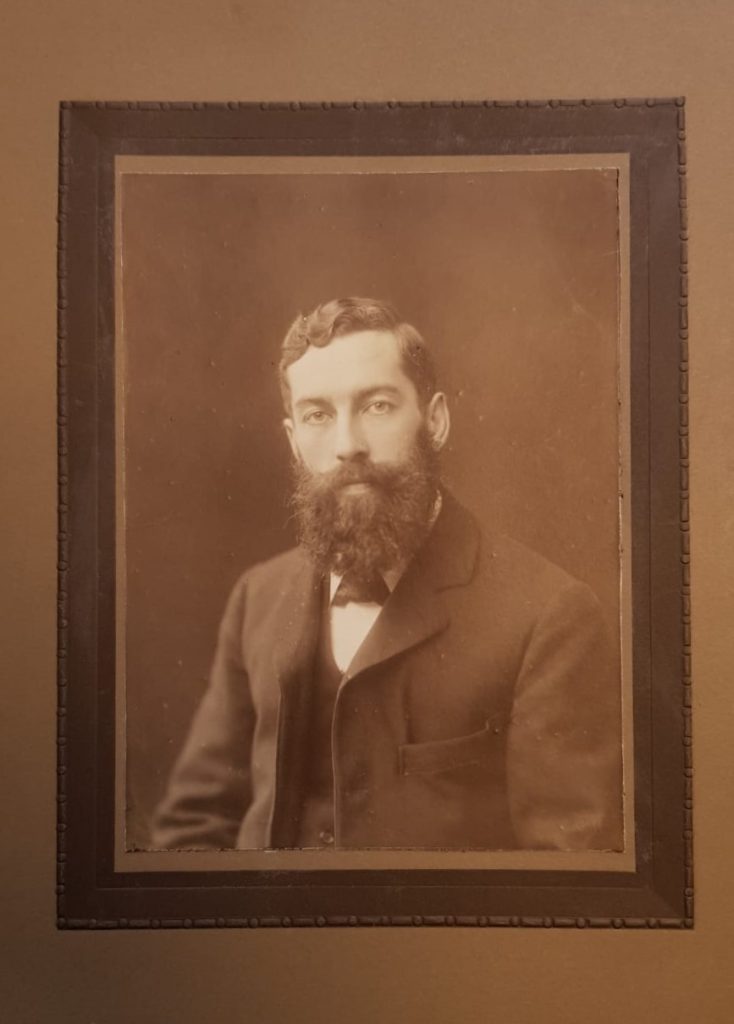
Abstract: Ernest Worman was the first scholar to experience what many of us have come to recognise as the ‘salt-mine’ of the Genizah. Already seven decades before the founding of the Genizah Research Unit (GRU), he toiled away in the depths of Cambridge University Library (CUL), documenting fragment after fragment that, for the most part, did not move the needle of history one way or the other. Many of his greatest successes were secondary, research performed on behalf of other scholars who needed a librarian’s assistance in their own career-defining projects. He died tragically young, but his history is still entangled with that of the GRU and CUL. That said, Worman himself may have preferred to be remembered for his activities outside of academia. He was a devout Christian, a talented musician, an avid boater, and a committed activist for the wellbeing of young men. This article documents his life spent in service to the Cambridge community and the legacy he left behind for modern Genizah scholars.
Read here: https://doi.org/10.17613/1e96d-tcw56
Cite this work: Posegay, Nick. 2024. “Ernest James Worman and the Victorian Genizah: A Salt-Miner’s Tale of Romance, Tax Evasion, and Sudden Death.” From the Battlefield of Books: Essays Celebrating 50 Years of the Taylor-Schechter Genizah Research Unit, eds. Nick Posegay, Magdalen M. Connolly, and Ben Outhwaite. Cambridge Genizah Studies Series, 16. Leiden: Brill, 239–258, https://doi.org/10.1163/9789004712331_017.
“Five Qur’anic Papyri from the Michaelides Collection at the Cambridge University Library” (2024)
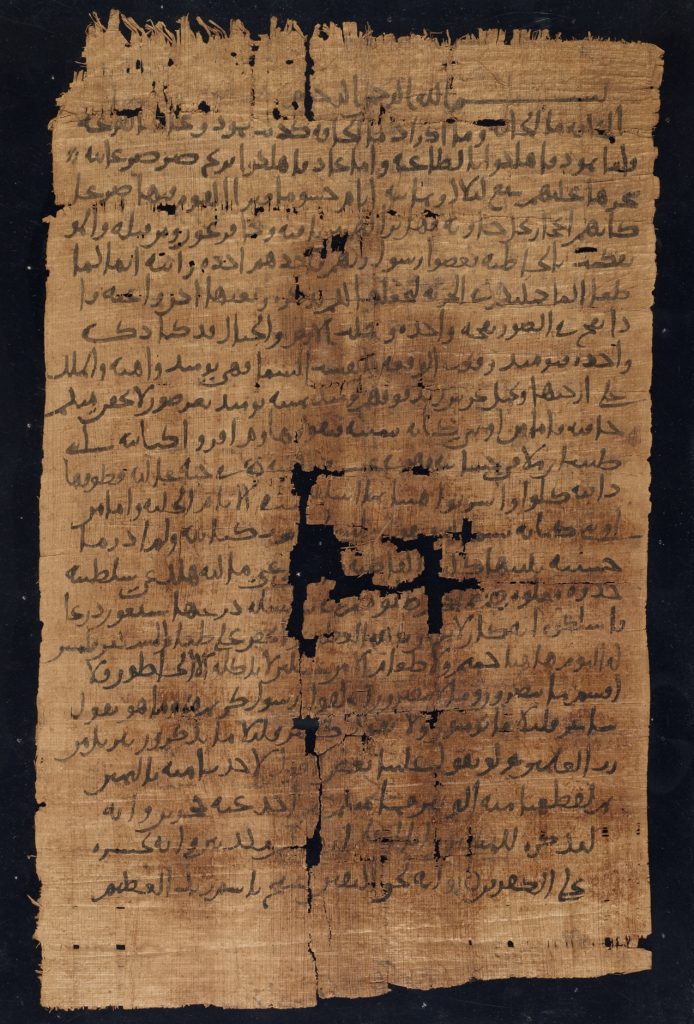
Abstract: The Michaelides manuscript collection at the Cambridge University Library contains approximately 700 papyrus fragments collected by George Michaelides in Egypt in the middle of the twentieth century. While a preliminary handlist exists for this collection, most of the papyri have not been fully described. Among them are five Qur’anic papyri that have thus far evaded analysis by scholars of Qur’anic history. Of those five, one is an an amulet, one is a longer text that quotes the entirety of Sūrat al-Fātiḥa, and three contain passages from one or two other suras. Of particular note is the fifth papyrus, CUL Mich.Pap.D.1415, which contains two whole suras, approaches the size of model codices, and may have once been bound. This article more fully describes these five manuscripts and transcribes their contents to provide new data for the textual and material transmission of the Qur’an during the second/eighth and third/ninth centuries.
Read here: https://doi.org/10.17613/ch3br-t5e43
Cite this work: Posegay, Nick. 2024. “Five Qurʾanic Papyri from the Michaelides Collection at the Cambridge University Library.” Journal of Qurʾanic Studies, 26.1, 101-124, https://doi.org/10.3366/jqs.2024.0570.
“Eleven Colophons by Ten Printers from Seven Cities in the Cairo Genizah” (2024)
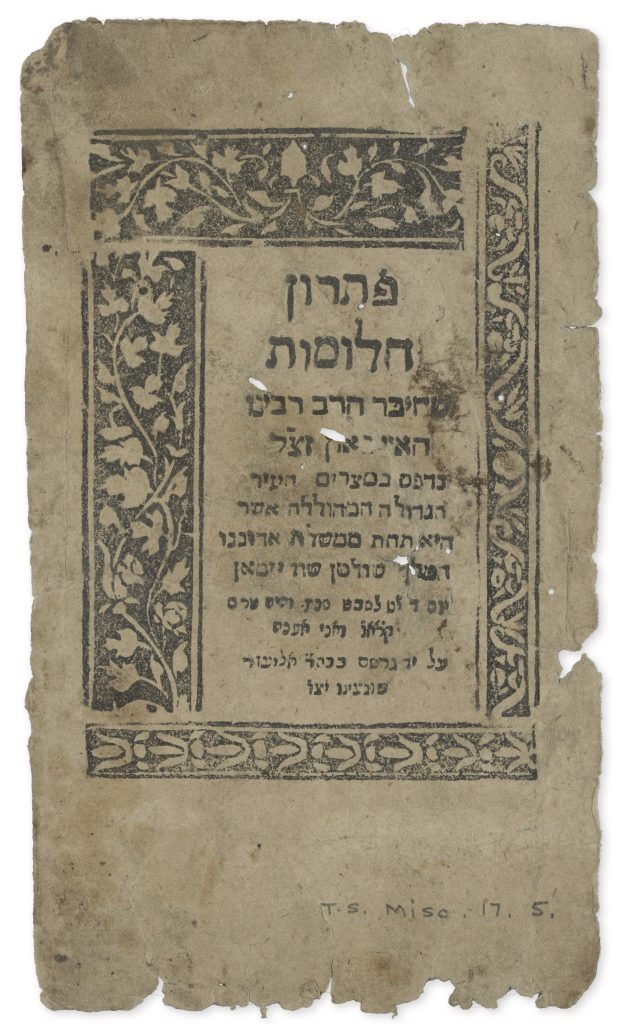
Abstract: While the Cairo Genizah is mainly known as a repository of medieval manuscripts, modern Genizah collections also contain thousands of folios from texts printed with moveable type between 1500 and 1900. Most of these imprints come from Europe, but almost all of them reached the Cairene Jewish community at some point before 1897. They are also among the least-studied Genizah fragments due to the fact that, for the last 125 years, almost all Genizah scholars have been medievalists and palaeographers. The goal of this article is to present colophons that show the variety of printed items that Cairene Jews had access to during the early modern period, as well as demonstrate the potential value of Genizah material as evidence in the history of Hebrew printing. It is further intended as a guide for Genizah scholars who may yet take interest in printed fragments.
Read here: https://doi.org/10.17613/g2ypb-ryb19
Cite this work: Posegay, Nick. 2024. “Eleven Colophons by Ten Printers from Seven Cities in the Cairo Genizah.” Literary Snippets: A Colophon Reader, eds. George A. Kiraz and Sabine Schmidtke. Piscataway, NJ: Gorgias Press, 25-37, https://doi.org/10.31826/9781463244033-005.
“An Early Arabic Translation of Exodus 15 from a Palestinian Melkite Psalter in the Cairo Genizah” (2024)

Abstract: This article presents an Arabic translation of Exodus 15 from the Cairo Genizah, preserved in two fragments of a Christian psalter (MSS CUL T-S NS 305.198 and T-S NS 305.210). The style of the psalter’s Arabic script suggests that it was copied by a well-trained scribe in the late 9th or early 10th century. Such a date makes it the oldest Christian Arabic Bible translation yet found in the Genizah. Linguistic analysis further indicates that its translator had access to the Peshitta and either the Syro-Hexapla or Septuagint of Exodus 15 during their work. Most likely, this translator was a ninth-century Melkite Christian who spoke both Syriac and Arabic.
Read here: https://doi.org/10.17613/6rdpb-14v91
Cite this work: Posegay, Nick. 2024. “An Early Arabic Translation of Exodus 15 from a Palestinian Melkite Psalter in the Cairo Genizah.” Collectanea Christiana Orientalia 21, 97-120, https://journals.uco.es/cco/article/view/16681.
“Hebrew Printing and Printers’ Colophons in the Cairo Genizah: Networking Book Trade in Europe and the Ottoman Empire” (2023)
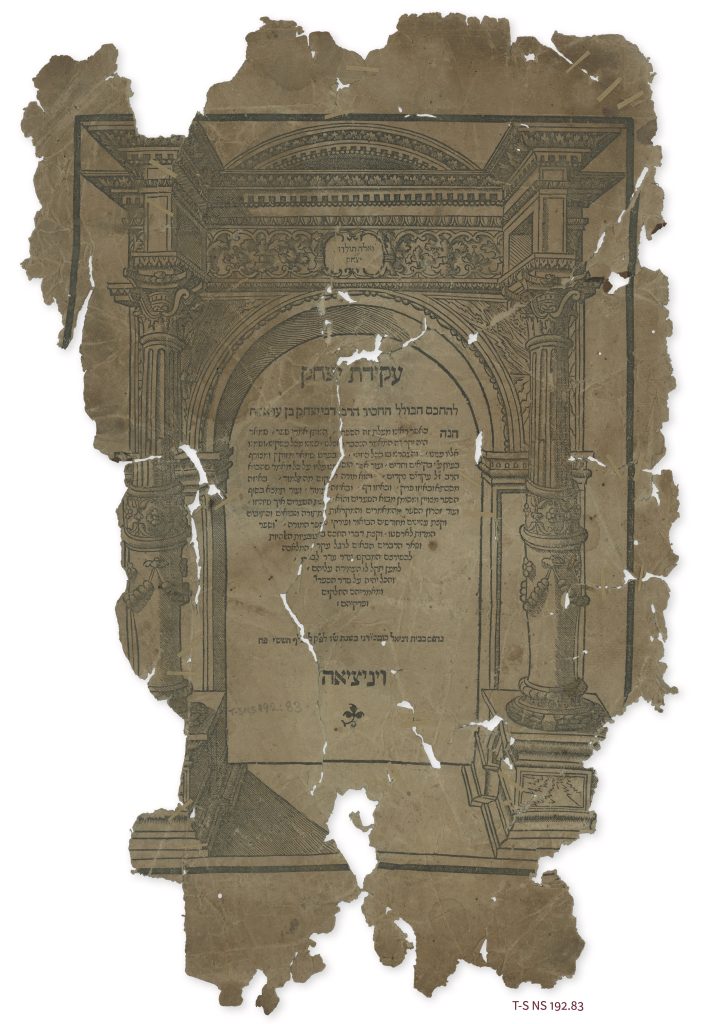
Abstract: The Cairo Genizah is famous as a source of manuscripts for the study of the medieval Mediterranean world, especially Jewish communities during the High Middle Ages. However, among the hundreds of thousands of Middle Eastern manuscript fragments in Genizah collections are more than 12,000 moveable-type printed items, most of which come from Europe. They are the remnants of a significant trade in Hebrew-script books that crossed the Mediterranean in the centuries following Gutenberg’s printing press. This corpus is severely understudied, with few previous surveys of printed Genizah material and no systematic cataloguing data currently available to organise it. This article takes several steps to rectify this situation by examining 57 printers’ colophons in Genizah collections. The resulting analysis allows a preliminary reconstruction of the European and Ottoman networks through which Cairene Jews obtained Hebrew books between 1500 and 1900. This paper also serves as an introduction to Hebrew printing for Cairo Genizah scholars and an introduction to the Cairo Genizah for specialists in Hebrew printing.
Read here: https://doi.org/10.17613/fxs7w-png32
Cite this work: Posegay, Nick. 2023. “Hebrew Printing and Printers’ Colophons in the Cairo Genizah: Networking Book Trade in Europe and the Ottoman Empire.” Literary Snippets: Colophons Across Space and Time, eds. George A. Kiraz and Sabine Schmidtke. Gorgias Handbooks, 64. Piscataway, NJ: Gorgias Press, 79-105, https://doi.org/10.31826/9781463244019-006.
“Searching for the Last Genizah Fragment in Late Ottoman Cairo: A Material Survey of Egyptian Jewish Literary Culture” (2022)
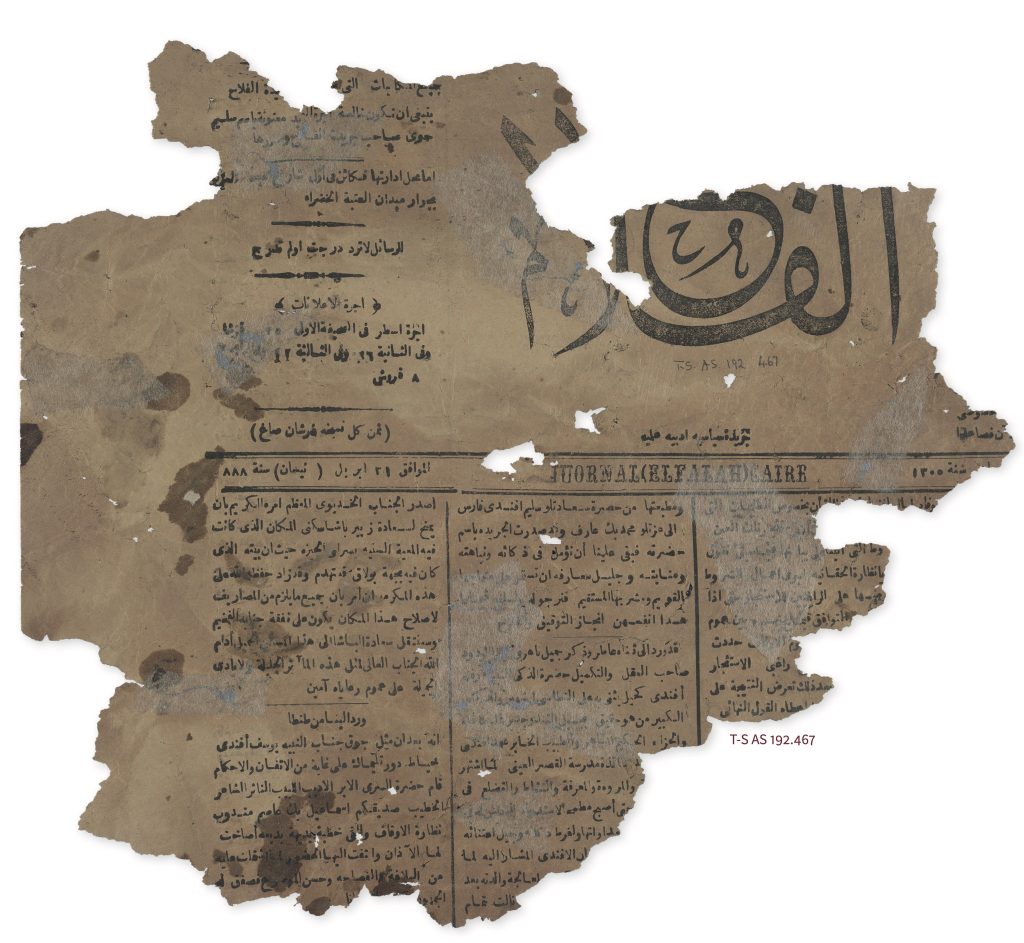
Abstract: The Cairo Genizah is well known as a repository for hundreds of thousands of manuscripts that the Jewish residents of Fustat (Old Cairo) produced and consumed in the premodern period. Foreign “collectors” acquired most of these manuscripts for European libraries in the second half of the nineteenth century, with the majority arriving at the Cambridge University Library in 1897 under the auspices of Solomon Schechter. Less well known is the fact that hundreds of Genizah fragments were produced in the late nineteenth century, even as European collectors were scouring Cairo for ancient texts. This later corpus includes witnesses to the social and economic history of late Ottoman Cairo and provides copious evidence for the material history of Egyptian Jewish literary activity at that time. Despite this, it remains understudied for both Ottoman and Jewish history. Late Genizah material also raises questions about the integrity of “Cairo Genizah” manuscript collections around the world, as some fragments postdate Schechter’s Genizah “discovery,” and others were never in Egypt at all.
Read here: https://doi.org/10.17613/pe4x9-8dw96
Cite this work: Posegay, Nick. 2022. “Searching for the Last Genizah Fragment in Late Ottoman Cairo: A Material Survey of Egyptian Jewish Literary Culture.” International Journal of Middle East Studies, 423-441, https://doi.org/10.1017/S0020743822000356.
“A Survey of Personal-Use Qurʾan Manuscripts Based on Fragments from the Cairo Genizah” (2021)
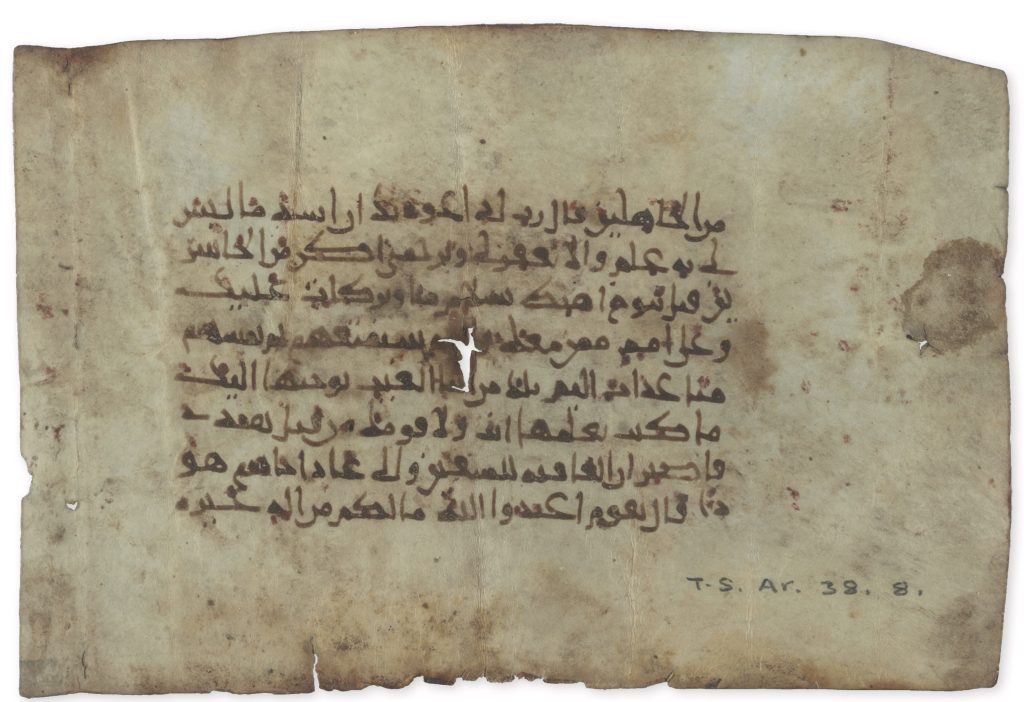
Abstract: The Cairo Genizah is a repository of texts spanning more than a millennium of Jewish history, including thousands of Hebrew and Judaeo-Arabic manuscripts now held in collections around the world. Among these are fragments from at least 25 separate Qur’an manuscripts in Arabic script, all of which lack any traces of Hebrew writing. Their palaeographic and codicological features do not differ from personal Qur’an manuscripts found in other contexts, and their varied characteristics suggest they were placed into the Genizah at different points throughout its history. They thus provide a diachronic corpus for the study of Arabic writing, the transmission of the Qur’an, and Jewish peoples’ engagement with the Qur’an in Islamicate lands. This paper describes these 25 personal-use Qur’an manuscripts in terms of their material history and orthography, while commenting on their place in the Genizah and the history of the Qur’an.
Read here: https://doi.org/10.17613/j8qxf-zka46
Cite this work: Connolly, Magdalen M. and Nick Posegay. 2021. “A Survey of Personal-Use Qurʾan Manuscripts Based on Fragments from the Cairo Genizah.” Journal of Qurʾanic Studies 23.2, 1-40, https://doi.org/10.3366/jqs.2021.0465.
“The Marking of Poetry: A Rare Vocalization System from an Early Qurʾān Manuscript in Chicago, Paris, and Doha” (2021)
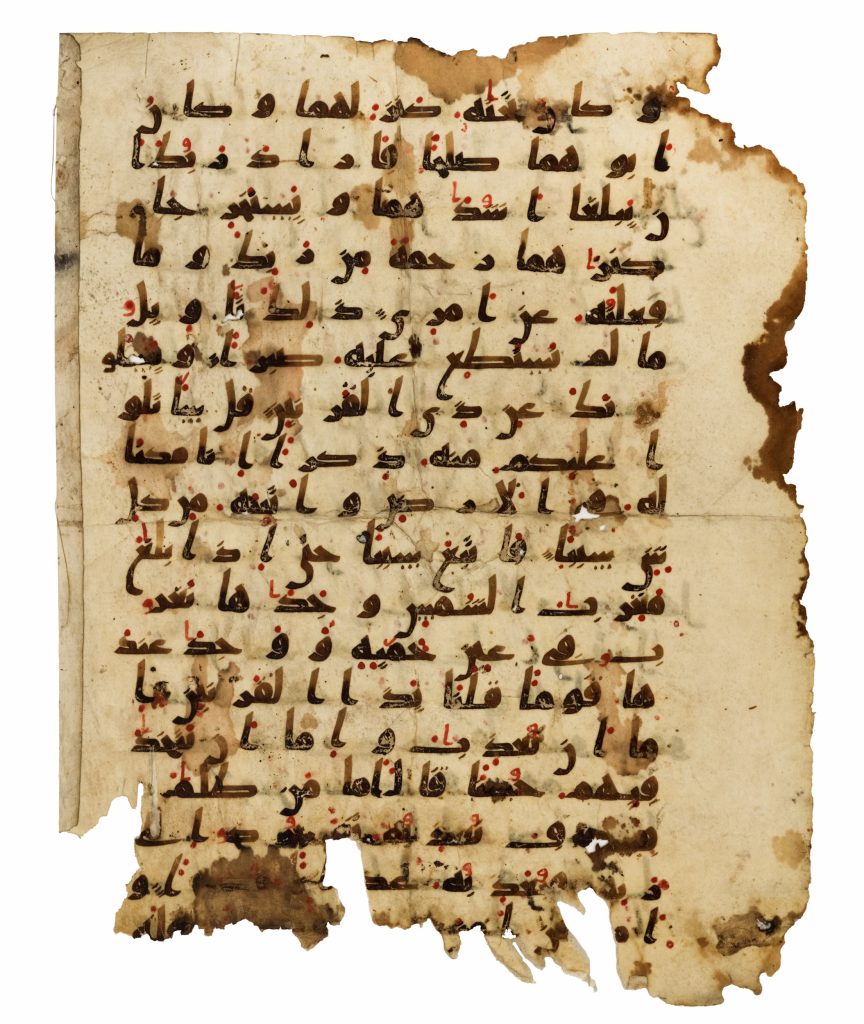
Abstract: This paper provides updated digital images of four Qurʾān fragments from Chicago’s Oriental Institute Museum (OIM) that appeared in Nabia Abbott’s Rise of the North Arabic Script, and calls attention to features of their paleography and vocalization which are not apparent from her original black-and-white plates. In doing so, it demonstrates that these four fragments all belong to the same copy of the Qurʾān, which is also the same Qurʾān as nineteen leaves in Paris’ Bibliothèque Nationale de France (BNF) and two leaves in Doha’s Museum of Islamic Art (MIA). All twenty-five folios of this Qurʾān contain a unique vocalization system that represents /a/ and /u/ with miniature red forms of alif and wāw. This system of “letter-form” vocalization signs is unattested in other Qurʾān manuscripts and corresponds with a type of vocalization which medieval sources describe as shakl al-shiʿr: “the marking of poetry.” The subsequent discussion analyzes the features of this shakl al-shiʿr system and contextualizes it within the history of both this Qurʾān manuscript and the history of Arabic writing as a whole.
Read here: https://doi.org/10.17613/at593-t9a53
Cite this work: Posegay, Nick. 2021. “The Marking of Poetry: A Rare Vocalization System from an Early Qurʾān Manuscript in Chicago, Paris, and Doha.” Journal of Near Eastern Studies 80.1, 73-89, https://www.journals.uchicago.edu/doi/10.1086/712876.
“To Belabour the Points: Encoding Vowel Phonology in Syriac and Hebrew Vocalization” (2021)
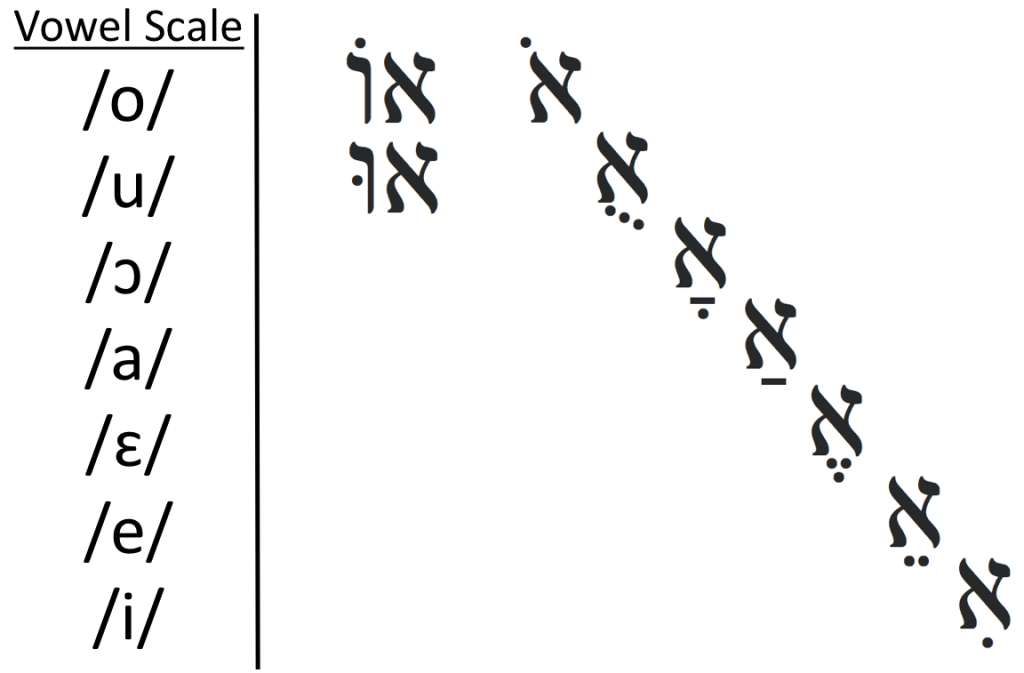
Abstract: Medieval Hebrew and Syriac scribes both indicated vowels by placing dots above or below their consonantal writing. These vowel points were created in the Late Antique and early Islamic periods to disambiguate the vocalization of important texts, especially the Bible. The earliest step in this process was the implementation of the Syriac ‘diacritic dot’ system, which used a single dot to distinguish pairs of homographs: a dot ‘above’ marked a word with relatively-backed vowels, and a dot ‘below’ marked its homograph with relatively-fronted vowels. This graphic depiction conveyed a phonological association of ‘height’ with ‘backness’, and that association then entered the Masoretic Hebrew tradition in the form of milleʿel (‘above’) and milleraʿ (‘below’) homograph comparisons. In turn, this principle of backness as ‘height’ informed the later placement of both the Syriac and the Tiberian Hebrew vowel points.
Read here: https://doi.org/10.17613/e787c-zz296
Cite this work: Posegay, Nick. 2021. “To Belabour the Points: Encoding Vowel Phonology in Syriac and Hebrew Vocalization.” Journal of Semitic Studies LXVI (1), 53-76, https://doi.org/10.1093/jss/fgaa045.
“Men of Letters in the Syriac Scribal Tradition: Dawid bar Pawlos, Rabban Rāmišoʿ, and the Family of Beṯ Rabban” (2021)
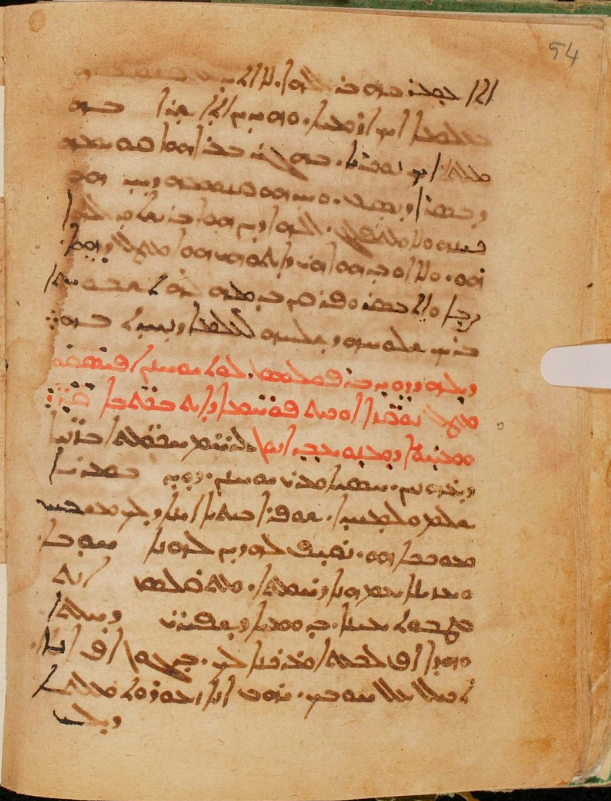
Abstract: Dawid bar Pawlos’ Letter on Dots is an eighth-century text that purportedly describes the introduction of some of the dots used in Syriac writing. It also sheds light on the life of a certain Rāmišoʿ of Beṯ Rabban, apparently the same man as the master of pointing named in MS BL Add. 12138. However, most studies of Syriac dots either neglect or completely discount this letter as a reliable source, since it suggests that Miaphysite scribes had a direct influence on East Syriac reading traditions. This article provides a more critical analysis of the letter, first examining the problematic state of its extant manuscripts, and then evaluating the text to determine its historical plausibility in the context of seventh-century northern Mesopotamia.
Read here: https://doi.org/10.17613/n3y3h-4e807
Cite this work: Posegay, Nick. 2021. “Men of Letters in the Syriac Scribal Tradition: Dawid bar Pawlos, Rabban Rāmišoʿ, and the Family of Beṯ Rabban.” Hugoye: Journal of Syriac Studies 24.1, 127-186.
“Hissing, Gnashing, Piercing, Cracking: Naming Vowels in Medieval Hebrew” (2021)

Abstract: The modern names for the Hebrew vowels (qameṣ, pataḥ, segol, ṣere, ḥiriq/ḥireq, ḥolem, shuruq/shureq, qibbuṣ/qubbuṣ) are derived from a variety of medieval sources. The pair of qameṣ and pataḥ are the oldest, both having evolved in the earliest stages of Masoretic analysis of vocalisation. The remaining names are products of three different conventions. Ṣere, ḥiriq, ḥolem, and shuruq descend from four Aramaic technical terms that described the physical articulation of vowel phonemes during the ninth century. Additionally, segol describes the shape of its three-dot vowel sign in the Tiberian pointing tradition, while qibbuṣ is a Hebrew calque of an Arabic grammatical term. This article traces the evolution of these terms during the early medieval period alongside other vowel names that have not survived to the modern day.
Read here: https://doi.org/10.17613/m6hsc-xe921
Cite this work: Posegay, Nick. 2021. “Hissing, Gnashing, Piercing, Cracking: Naming Vowels in Medieval Hebrew.” New Perspectives in Biblical and Rabbinic Hebrew, eds. Aaron D. Hornkohl and Geoffrey Khan. Cambridge Semitic Languages and Cultures, 7. Cambridge: Open Book Publishers, 29-55, https://doi.org/10.11647/OBP.0250.02.
“Three Fragments of a Judaeo-Arabic Translation of Ecclesiastes with Full Tiberian Vocalisation” (2021)
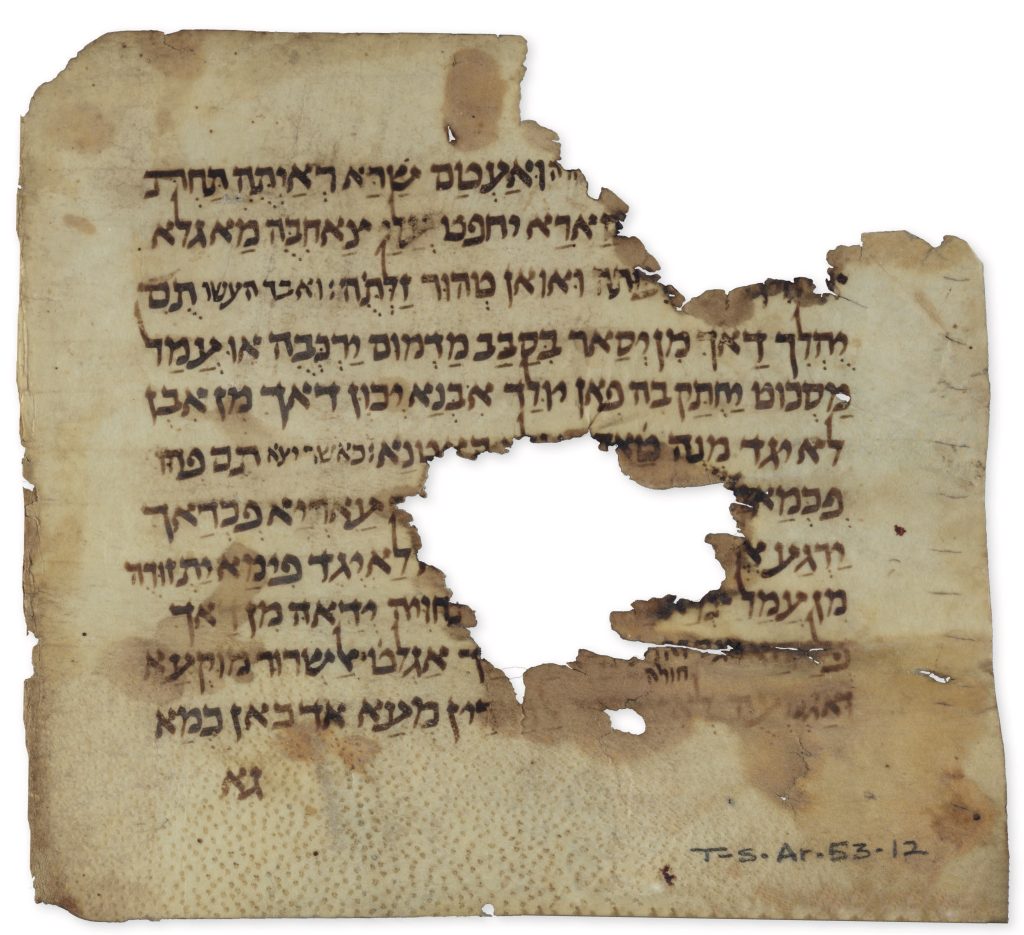
Abstract: Judaeo-Arabic manuscripts with complete vocalisation are rare, a problem which makes reconstructing the pronunciation of the medieval language challenging. This study presents an edition of a Judaeo-Arabic translation of Ecclesiastes from the Cairo Genizah with full Tiberian vocalisation. This manuscript exhibits noteworthy features of dialectal medieval Arabic and a palaeographic style which places it in twelfth-century Egypt-Palestine. The transcription system provides specific evidence for the pronunciation of a type of medieval Judaeo-Arabic, while the translation offers a window into the culture of popular Bible translations and scribal activity in the medieval Middle East.
Read here: http://doi.org/10.17613/expar-qnz86
Cite this work: Posegay, Nick and Estara J Arrant. 2021. “Three Fragments of a Judaeo-Arabic Translation of Ecclesiastes with Full Tiberian Vocalisation.” Intellectual History of the Islamicate World 9.3, 259-296, https://doi.org/10.1163/2212943X-bja10001.
“Connecting the Dots: The Shared Phonological Tradition in Syriac, Arabic, and Hebrew Vocalisation” (2020)
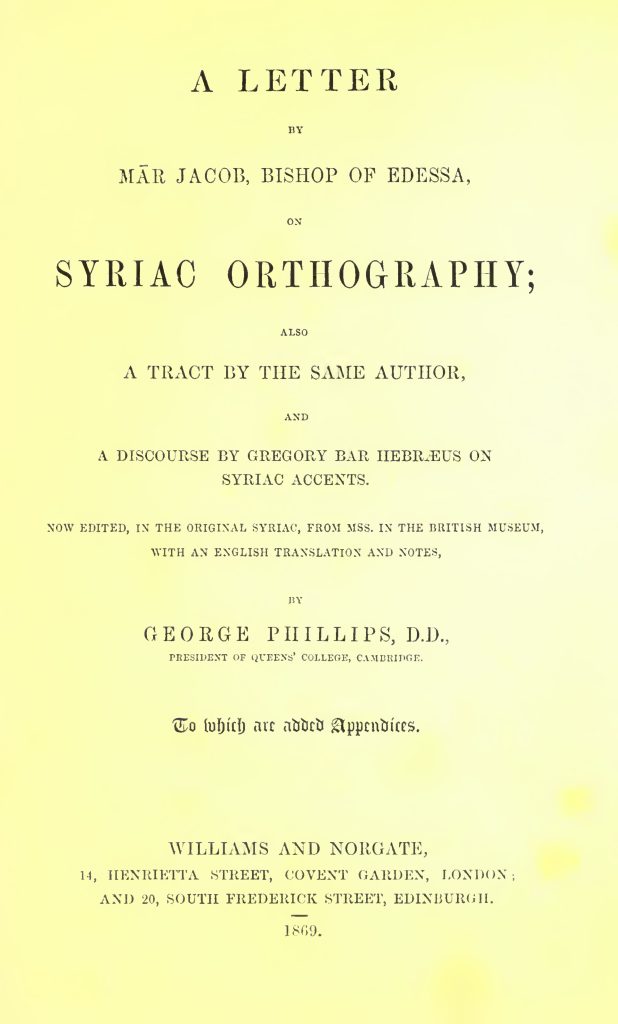
Abstract: This article presents new data on links between the various medieval vocalisation traditions of Hebrew, Syriac, and Arabic. These include the identification of overlaps in the Aramaic terminology used by Jewish Masoretes and Syriac Christian grammarians and in the phonological theories that underlie them, as well as connections between Syriac and Arabic grammarians. It thus provides evidence that the systems did not develop in isolation, but were the result of intellectual exchanges between various religious communities.
Read here: http://doi.org/10.17613/sz8e8-yvh85
Cite this work: Posegay, Nick. 2020. “Connecting the Dots: The Shared Phonological Tradition in Syriac, Arabic, and Hebrew Vocalisation.” Studies in Semitic Vocalisation and Reading Traditions, eds. Aaron D. Hornkohl and Geoffrey Khan. Cambridge Semitic Languages and Cultures, 3. Cambridge: Open Book Publishers, 191-226, https://doi.org/10.11647/OBP.0207.06
“‘An Arabic Qurʾān, That You Might Understand’: Qurʾān Fragments in the T-S Arabic Cairo Genizah Collection” (2020)
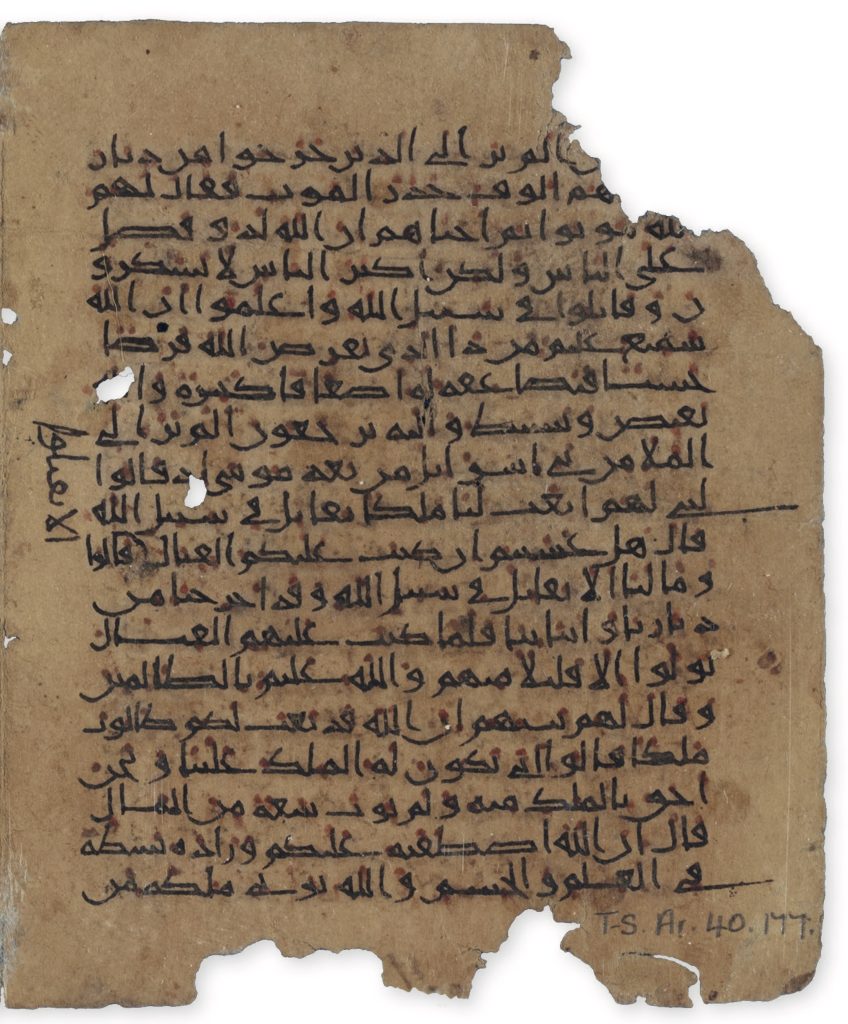
Abstract: The Arabic-script Qurʾān fragments of the Cairo Genizah collections have not yet drawn much interest among Arabic and genizah scholars. This paper aims to bring them to the attention of a broader audience by presenting the palaeographic features (§3) and vocalisation systems (§4) of eleven Arabic-script Qurʾān fragments from the Cambridge University Library’s Taylor-Schechter Arabic collection. While the focus of this paper is the physical appearance of these Qurʾān leaves, their presence in the Cairo genizah (§1.1) – a Jewish ‘storeroom’ for retired sacred texts – is also tentatively explored (§1.2, §5).
Read here: http://doi.org/10.17613/fvjye-qdz64
Cite this work: Connolly, Magdalen M. and Nick Posegay. 2020. “‘An Arabic Qurʾān, that you might understand’: Qurʾān Fragments in the T-S Arabic Cairo Genizah Collection.” Journal of Islamic Manuscripts 11 (3), 292-351, https://doi.org/10.1163/1878464X-01103002.
“A Judaeo-Arabic Biblical Glossary as a Source for Arabic Historical Dialectology” (2020)
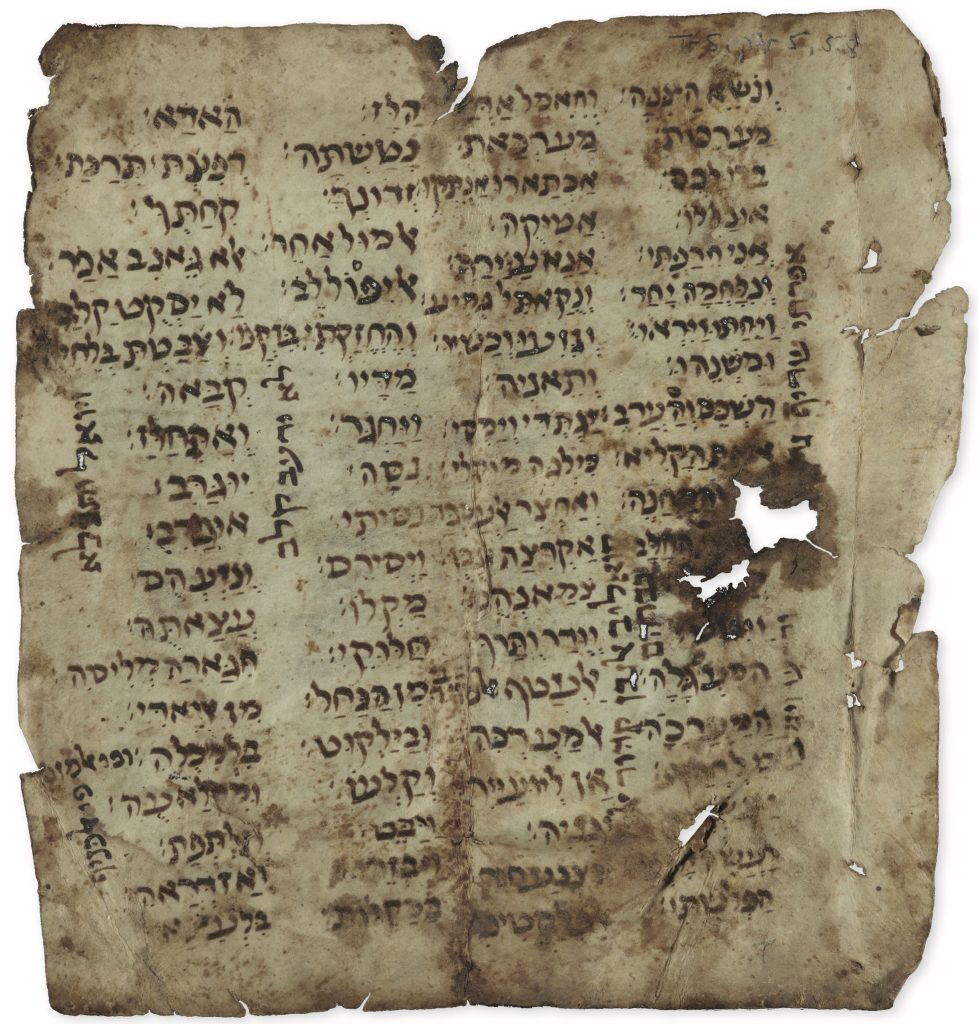
Abstract: MS T-S Ar.5.58 is a translation glossary from the Cairo Geniza that contains a list of Judaeo-Arabic glosses for Hebrew words from the biblical book of Samuel. These Arabic words are fully vocalised with the Tiberian Hebrew pointing system, providing more precise phonetic information about the scribe’s native Arabic dialect than could be expressed with standard Arabic vowel signs. This pointing reveals linguistic features known from modern varieties of vernacular Arabic, including a conditional tendency to raise /a/ to /e/ and a reflex of ǧīm as /g/. The manuscript can be dated between the tenth and twelfth centuries, making it an important source for the history of spoken medieval Arabic and Middle Arabic writing.
Read here: https://doi.org/10.17613/4vm7r-69406
Cite this work: Posegay, Nick. 2020. “A Judaeo-Arabic Biblical Glossary as a Source for Arabic Historical Dialectology.” Journal of Arabic and Islamic Studies 20, 33-52, https://doi.org/10.5617/jais.7863.
“Illuminating an Illuminated Islamic Document: The Twin Arts of Calligraphy and Embroidery in Fatimid Egypt (T-S K10.12)” (2024)
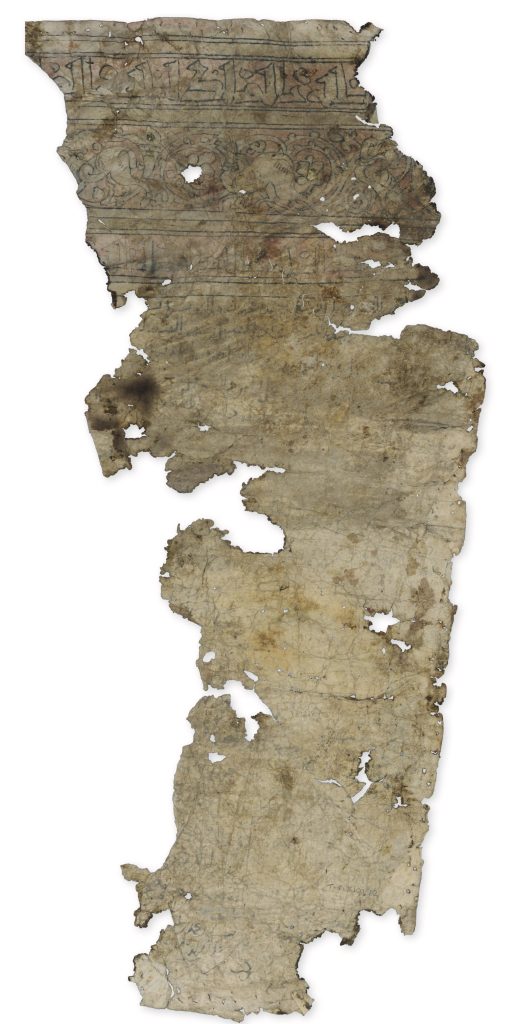
Abstract: It’s been more than five years since I started working for the Genizah Research Unit here in Cambridge. Since then, I’ve written six Fragment of the Month articles – some of them even good – about Genizah fragments that I’ve found particularly interesting or challenging to interpret. My time in Cambridge ends with this month, and I am so grateful for the support of the Genizah Research Unit and University Library since 2019. I am equally grateful for the support of all our Fragment of the Month readers, so here’s one last manuscript mystery for the road.
The fragment for this month is T-S K10.12. It is quite large for a Genizah fragment, measuring 53.2 x 25.5 cm. It’s made of parchment and has a vertical ‘rotulus’ format, much taller than it is wide, typical of magical amulets, petitions, and certain other legal documents found in the Genizah. The most striking portion is the top third, which has two illuminated bands of ornamental Arabic calligraphy flanking a series of illustrated animals on a red background. Don’t worry, we will get to them – but first we have to figure out what this manuscript actually is.
Cite this work: Posegay, Nick. 2024. “Illuminating an Illuminated Islamic Document: The Twin Arts of Calligraphy and Embroidery in Fatimid Egypt (T-S K10.12).” Fragment of the Month (August). Cambridge: University Library Genizah Research Unit.
“The Long Road to Samarqand: Reverse-Engineering the Travels of a 12th-Century Andalusi Muslim (T-S Ar.53.39)” (2023)

Abstract: Over the last 5 years, I have written about several different Cairo Genizah manuscripts for our Fragment of the Month series. Most of the time, I pick a fragment that I’ve spent many days studying to identify what it is and where it came from. These manuscript mysteries often lead to new discoveries that can be fun to figure out, but not every Genizah fragment is so mysterious. The truth is, many tell us exactly what they are.
The trick is recognising how any fragment we’re looking at fits into the wider story of the Genizah and the Middle East. Does it tell us something new about an understudied historical phenomenon? Is the text from a lost work or does it survive in other manuscripts? Are there records of the author elsewhere or is this the only reference to them? Is it an original document or a copy taken out of context? This month’s fragment is one of those manuscripts that is exactly what it says on the tin. It offers us a glimpse into the 12th-century intellectual world and the long journey of a forgotten Muslim scholar from southern Spain.
Cite this work: Posegay, Nick. 2023. “The Long Road to Samarqand: Reverse-Engineering the Travels of a 12th-Century Andalusi Muslim (T-S Ar.53.39).” Fragment of the Month (October). Cambridge: University Library Genizah Research Unit.
“Solving European Writer’s Block in Jewish Cairo (T-S 20.188)” (2023)
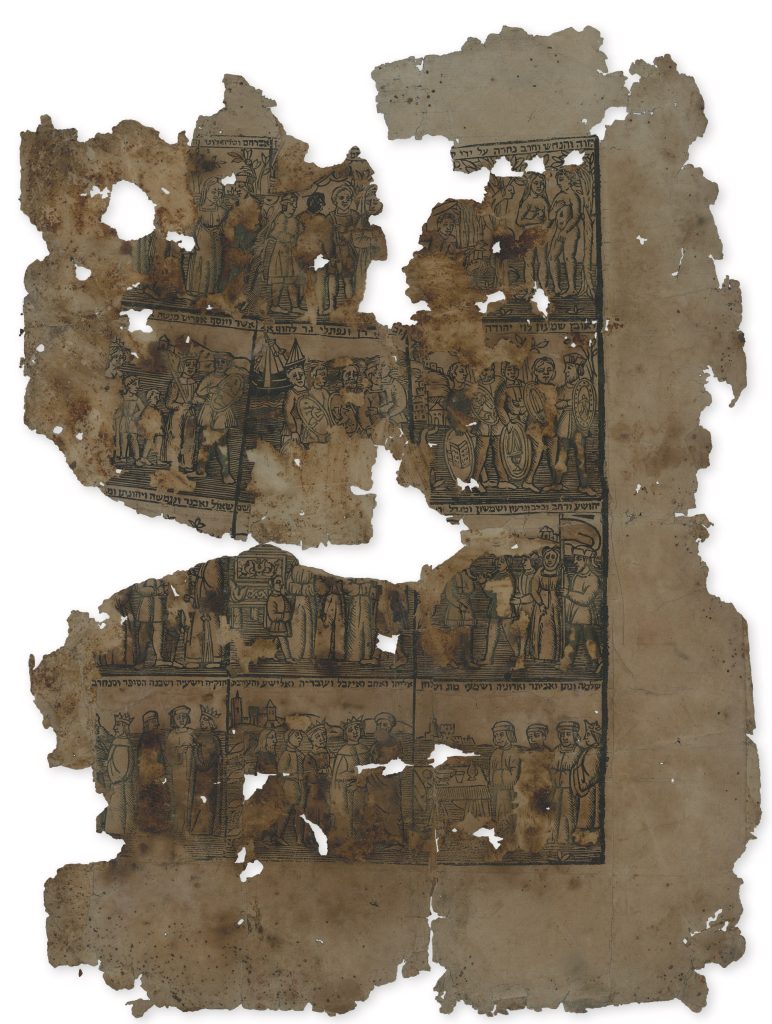
Abstract: One of the duties of the Cambridge Genizah Research Unit (GRU) is to identify and describe the manuscript fragments in the Taylor-Schechter Collection. That Collection contains almost 200,000 fragments, so this job is taking a while. Luckily, the GRU regularly employs experts in medieval Hebrew, Arabic, and Aramaic to catalogue the contents of medieval texts. This makes sense: those were the main written languages of medieval Cairene Jews. We want to identify the author, date and location of production for every manuscript in the Collection, so it is necessary to consult specialists in historical languages (‘philologists’), handwriting (‘palaeographers’) and manuscript production (‘codicologists’).
It is not, however, common for the GRU to employ experts for niche subsections of the Collection—things that are not handwritten, not Semitic languages or not medieval. For example, the Taylor-Schechter Collection contains thousands of pages from books printed between 1480 and 1897, but these are far less numerous than the earlier manuscripts that attract the philologists and palaeographers. Consequently, there are some items in the Collection that the GRU currently lacks experts to identify. This Fragment of the Month is one of those items.
Cite this work: Posegay, Nick. 2023. “Solving European Writer’s Block in Jewish Cairo (T-S 20.188).” Fragment of the Month (January). Cambridge: University Library Genizah Research Unit.
“Jewish Parchment, Muslim Prayer – Uncovering an Early Abbasid Palimpsest (T-S Ar.51.73)” (2021)
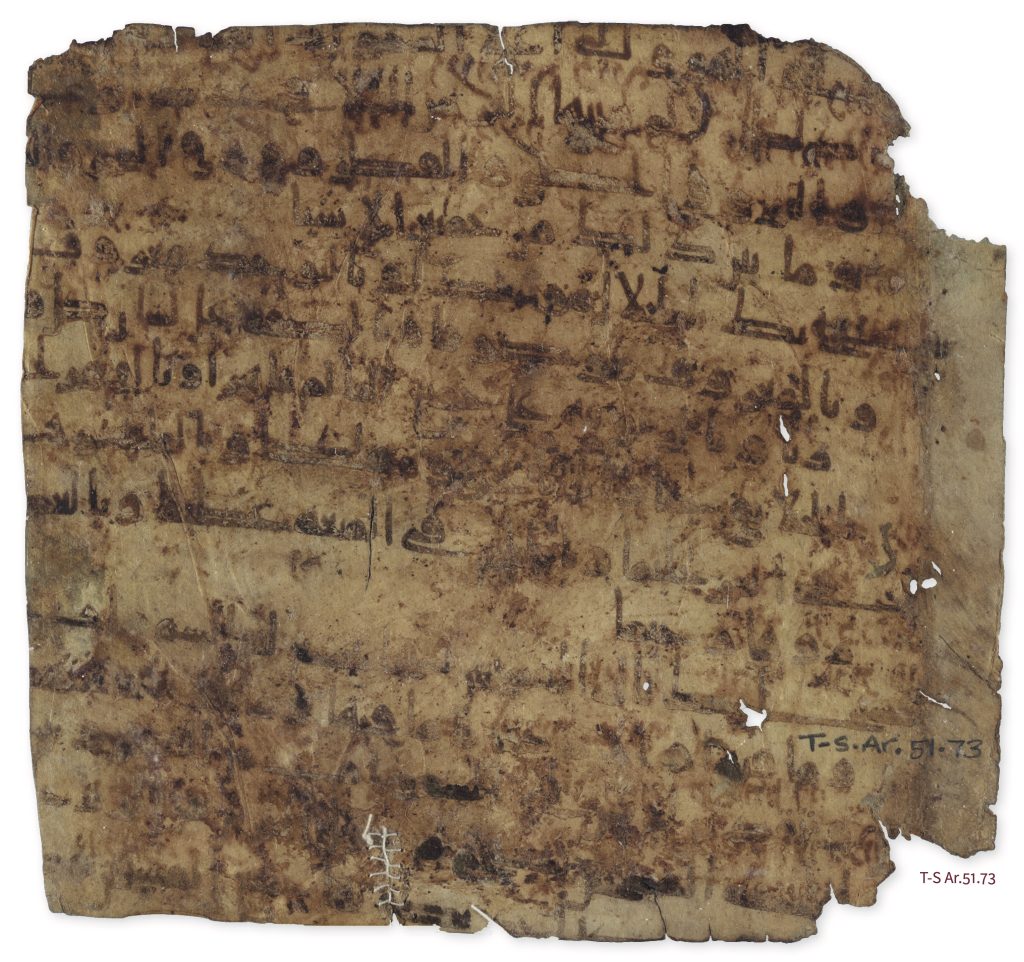
Abstract: Sometimes it takes a while to identify a Genizah fragment. No one is an expert in all the languages, genres, and scripts that appear in Genizah collections, and even for experts, it is often difficult to decipher severely damaged manuscripts. The Genizah Research Unit has worked for almost five decades to catalogue the Taylor-Schechter Collection, but it is not uncommon to spend several hours identifying a single fragment, so many thousands have still never been read.
I first tried to identify T-S Ar.51.73 in 2018 while surveying Genizah collections for manuscripts of the Qurʾan. The fragment stood out because it has an old style of Arabic script that usually indicates Qurʾanic writing. Damage to the manuscript meant I could not immediately decipher the entire text, but it quickly became clear that this was not a section of the Qurʾan. It went on a list of unidentified classmarks I have labeled “Suspicious Fragments,” and then I promptly forgot about it.
That is, until March of 2021, when I suddenly remembered T-S Ar.51.73 while cataloguing another Arabic fragment. I searched up the manuscript again when I was supposed to be doing my job, and it seems that no one else identified it in the interim, so here we are.
Cite this work: Posegay, Nick. 2021. “Jewish Parchment, Muslim Prayer: Uncovering an Early Abbasid Palimpsest (T-S Ar.51.73).” Fragment of the Month (June). Cambridge: University Library Genizah Research Unit.
“Following the Links in T-S NS 192.11: A Qurʾanic Exercise from a Cairene Public School” (2020)
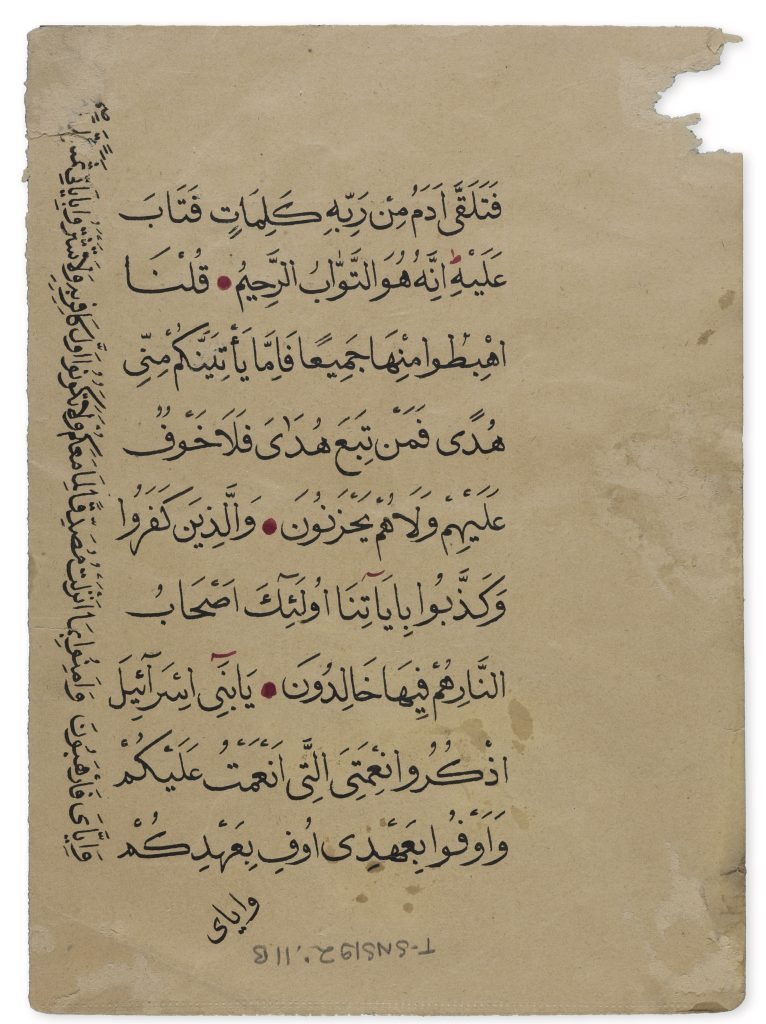
Abstract: No individual possesses the expertise required to understand every manuscript in the Genizah collections, so as researchers we must utilise all available resources to interpret what we find. Sometimes that means consulting long-forgotten tomes in the deepest vaults of the University Library, or squinting at microfilms that were surely cutting-edge at some point in the distant past. Other times we must travel to the far reaches of the globe, seeking aid abroad from generous colleagues and libraries with windows. In truly desperate times, we may even attempt to decipher the handwritten records of Goitein himself, eager for any overlooked philological detail amongst his nearly 30,000 individual notecards. This is not one of those times. This time, our most helpful tools were Facebook and Google Maps. Without them, we might never have identified the original scribe of T-S NS 192.11: a young student at a Cairene public school at the end of the nineteenth century.
Cite this work: Posegay, Nick. 2020. “Following the Links in T-S NS 192.11: A Qurʾanic Exercise from a Cairene Public School.” Fragment of the Month (January). Cambridge: University Library Genizah Research Unit.
Powered by WordPress
Pages
Social