Nick Posegay

Archives • Manuscripts • Interfaith History

About This Site

Thank you to me for making this site. Thank you to academia./edu for forcing my hand by making their own site unsuitable for hosting academic materials. Most of all, thank you to you, dear reader, for finding this weird sidebar.

The Arabo-Tiberian Vocalisation System: An Undocumented Set of Medieval Vowel Signs for the Hebrew Script (2025)

The three main Hebrew vocalisation systems—Tiberian, Palestinian, and Babylonian—are well-known in the history of Semitic languages. This article describes another previously undocumented Hebrew vocalisation system, the ‘Arabo-Tiberian system’, a sub-variant of the Tiberian system that appears only in Judaeo-Arabic manuscripts around the tenth and eleventh centuries. In addition to the typical Tiberian vowel marks, the

The Illustrated Cairo Genizah (2024)

Almost one thousand years ago, the Jews of Old Cairo began to place their worn-out books and scrolls into a hidden storage room – a genizah – of their synagogue. Over the years, they added all sorts of writings to the pile, sacred and secular texts alike. When the chamber was emptied at the end

Searching for the Last Genizah Fragment in Late Ottoman Cairo: A Material Survey of Egyptian Jewish Literary Culture (2022)

The Cairo Genizah is well known as a repository for hundreds of thousands of manuscripts that the Jewish residents of Fustat (Old Cairo) produced and consumed in the premodern period. Foreign “collectors” acquired most of these manuscripts for European libraries in the second half of the nineteenth century, with the majority arriving at the Cambridge

Hissing, Gnashing, Piercing, Cracking: Naming Vowels in Medieval Hebrew (2021)

The modern names for the Hebrew vowels (qameṣ, pataḥ, segol, ṣere, ḥiriq/ḥireq, ḥolem, shuruq/shureq, qibbuṣ/qubbuṣ) are derived from a variety of medieval sources. The pair of qameṣ and pataḥ are the oldest, both having evolved in the earliest stages of Masoretic analysis of vocalisation. The remaining names are products of three different conventions. Ṣere, ḥiriq,

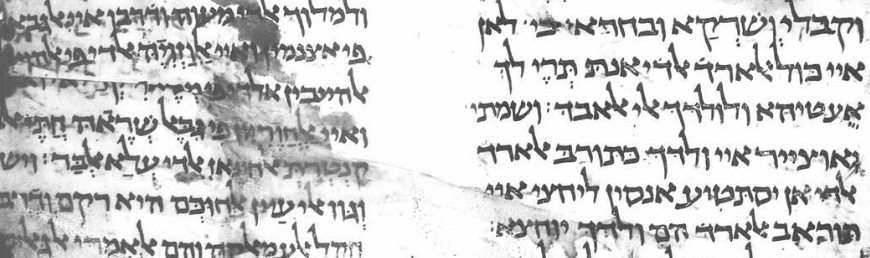
Three Fragments of a Judaeo-Arabic Translation of Ecclesiastes with Full Tiberian Vocalisation (2021)

Judaeo-Arabic manuscripts with complete vocalisation are rare, a problem which makes reconstructing the pronunciation of the medieval language challenging. This study presents an edition of a Judaeo-Arabic translation of Ecclesiastes from the Cairo Genizah with full Tiberian vocalisation. This manuscript exhibits noteworthy features of dialectal medieval Arabic and a palaeographic style which places it in

A Judaeo-Arabic Biblical Glossary as a Source for Arabic Historical Dialectology (2020)

MS T-S Ar.5.58 is a translation glossary from the Cairo Geniza that contains a list of Judaeo-Arabic glosses for Hebrew words from the biblical book of Samuel. These Arabic words are fully vocalised with the Tiberian Hebrew pointing system, providing more precise phonetic information about the scribe’s native Arabic dialect than could be expressed with