Nick Posegay

Archives • Manuscripts • Interfaith History

About This Site

Thank you to me for making this site. Thank you to academia./edu for forcing my hand by making their own site unsuitable for hosting academic materials. Most of all, thank you to you, dear reader, for finding this weird sidebar.

A Survey of Personal-Use Qurʾan Manuscripts Based on Fragments from the Cairo Genizah (2021)

The Cairo Genizah is a repository of texts spanning more than a millennium of Jewish history, including thousands of Hebrew and Judaeo-Arabic manuscripts now held in collections around the world. Among these are fragments from at least 25 separate Qur’an manuscripts in Arabic script, all of which lack any traces of Hebrew writing. Their palaeographic

The Marking of Poetry: A Rare Vocalization System from an Early Qurʾān Manuscript in Chicago, Paris, and Doha (2021)

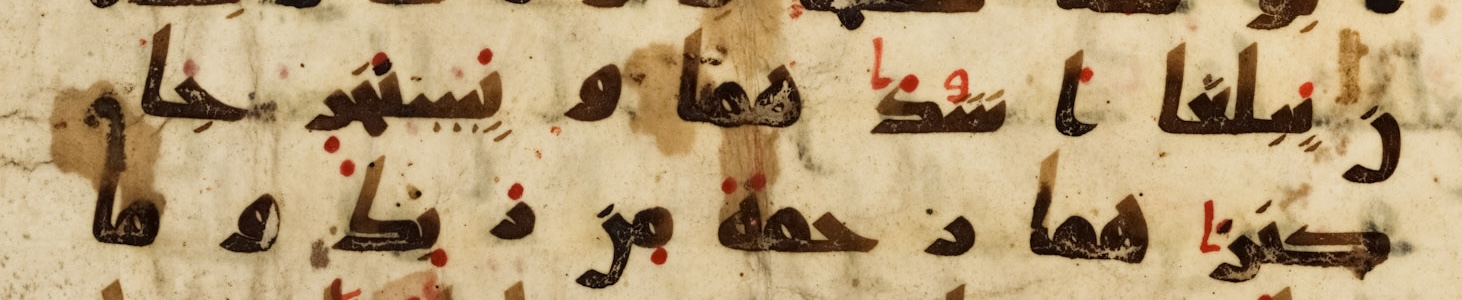
This paper provides updated digital images of four Qurʾān fragments from Chicago’s Oriental Institute Museum (OIM) that appeared in Nabia Abbott’s Rise of the North Arabic Script, and calls attention to features of their paleography and vocalization which are not apparent from her original black-and-white plates. In doing so, it demonstrates that these four fragments

To Belabour the Points: Encoding Vowel Phonology in Syriac and Hebrew Vocalization (2021)

Medieval Hebrew and Syriac scribes both indicated vowels by placing dots above or below their consonantal writing. These vowel points were created in the Late Antique and early Islamic periods to disambiguate the vocalization of important texts, especially the Bible. The earliest step in this process was the implementation of the Syriac ‘diacritic dot’ system,

Men of Letters in the Syriac Scribal Tradition: Dawid bar Pawlos, Rabban Rāmišoʿ, and the Family of Beṯ Rabban (2021)

Dawid bar Pawlos’ Letter on Dots is an eighth-century text that purportedly describes the introduction of some of the dots used in Syriac writing. It also sheds light on the life of a certain Rāmišoʿ of Beṯ Rabban, apparently the same man as the master of pointing named in MS BL Add. 12138. However, most

Hissing, Gnashing, Piercing, Cracking: Naming Vowels in Medieval Hebrew (2021)

The modern names for the Hebrew vowels (qameṣ, pataḥ, segol, ṣere, ḥiriq/ḥireq, ḥolem, shuruq/shureq, qibbuṣ/qubbuṣ) are derived from a variety of medieval sources. The pair of qameṣ and pataḥ are the oldest, both having evolved in the earliest stages of Masoretic analysis of vocalisation. The remaining names are products of three different conventions. Ṣere, ḥiriq,

Three Fragments of a Judaeo-Arabic Translation of Ecclesiastes with Full Tiberian Vocalisation (2021)

Judaeo-Arabic manuscripts with complete vocalisation are rare, a problem which makes reconstructing the pronunciation of the medieval language challenging. This study presents an edition of a Judaeo-Arabic translation of Ecclesiastes from the Cairo Genizah with full Tiberian vocalisation. This manuscript exhibits noteworthy features of dialectal medieval Arabic and a palaeographic style which places it in

Connecting the Dots: The Shared Phonological Tradition in Syriac, Arabic, and Hebrew Vocalisation (2020)

This article presents new data on links between the various medieval vocalisation traditions of Hebrew, Syriac, and Arabic. These include the identification of overlaps in the Aramaic terminology used by Jewish Masoretes and Syriac Christian grammarians and in the phonological theories that underlie them, as well as connections between Syriac and Arabic grammarians. It thus

‘An Arabic Qurʾān, That You Might Understand’: Qurʾān Fragments in the T-S Arabic Cairo Genizah Collection (2020)

The Arabic-script Qurʾān fragments of the Cairo Genizah collections have not yet drawn much interest among Arabic and genizah scholars. This paper aims to bring them to the attention of a broader audience by presenting the palaeographic features (§3) and vocalisation systems (§4) of eleven Arabic-script Qurʾān fragments from the Cambridge University Library’s Taylor-Schechter Arabic

A Judaeo-Arabic Biblical Glossary as a Source for Arabic Historical Dialectology (2020)

MS T-S Ar.5.58 is a translation glossary from the Cairo Geniza that contains a list of Judaeo-Arabic glosses for Hebrew words from the biblical book of Samuel. These Arabic words are fully vocalised with the Tiberian Hebrew pointing system, providing more precise phonetic information about the scribe’s native Arabic dialect than could be expressed with